
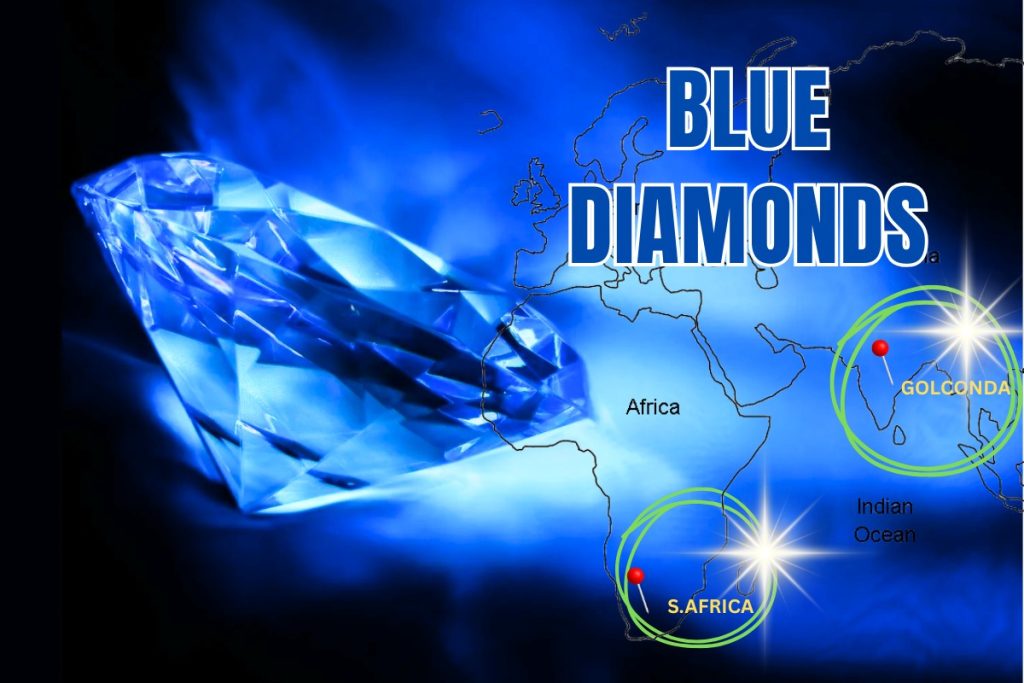
Blue diamonds are among the rarest and most scientifically fascinating gemstones ever discovered. Their mesmerizing color, extreme scarcity, and complex geological origins make them objects of intense study for gemologists and collectors alike. While blue diamonds occur in several regions, two of the most historically significant sources are the ancient mines of Golconda and the famous diamond-producing regions of South Africa. Though both yield blue diamonds colored primarily by boron impurities, the conditions under which they formed, their physical characteristics, and their historical contexts differ substantially.
GEOLOGICAL FORMATION DIFFERENCES
The most fundamental distinction lies in geological age and formation environment.
Golconda diamonds originated in extremely ancient deposits dating back billions of years. These diamonds were not mined from primary volcanic pipes but from secondary alluvial gravels formed when ancient volcanic sources eroded over time. This long natural transport process often removed flawed stones, leaving only the most structurally perfect crystals behind. As a result, Golconda diamonds—especially blue ones—are renowned for exceptional clarity and purity.
In contrast, most South African blue diamonds come directly from primary kimberlite pipes, such as those associated with the historic Kimberley Mine and the famous Cullinan Mine. These deposits formed when deep mantle eruptions brought diamonds rapidly to the Earth’s surface. Because they did not undergo extensive natural sorting, stones from these mines can exhibit a broader range of internal features and crystal qualities.
CHEMICAL CLAUSES OF BLUE COLOR
Both Golconda and South African blue diamonds derive their color primarily from trace amounts of boron atoms trapped within the carbon crystal lattice. Boron absorbs red light, allowing blue wavelengths to dominate. However, the structural environment of the boron differs subtly.
Golconda blue diamonds often possess extremely low nitrogen content and minimal lattice distortion. This results in a soft, velvety blue tone sometimes described as “liquid blue light.” Their color distribution is usually even and gentle rather than intense or steely.
South African blue diamonds can also be Type IIb (boron-bearing), but many show slight structural strain or additional trace elements. This can create deeper, steel-blue or gray-blue shades, sometimes with uneven color zoning visible under magnification.
CRYSTAL PURITY AND OPTICAL PERFORMANCE
Golconda diamonds have long been considered the benchmark for crystal purity. Their Type IIa and IIb classifications indicate almost complete absence of nitrogen and other impurities. This gives them extraordinary transparency and brilliance. Even among blue diamonds, Golconda stones are often described as having a glowing inner light rather than just surface sparkle.
South African blues can be equally beautiful, but statistically they show a higher probability of internal inclusions or minor structural irregularities. These features rarely diminish their beauty but can influence value when compared directly with top Golconda specimens.
RARITY AND MINING HISTORY
Another major difference lies in availability.
Golconda’s historic mines were largely depleted by the early modern period. Today, no significant new production emerges from the region. Every Golconda blue diamond on the market is therefore an antique stone with historical provenance. This finite supply dramatically increases their desirability and market value.
South African mines, on the other hand, continue to produce diamonds, including occasional blue specimens. Although blue diamonds remain extremely rare even there, the possibility of new discoveries means the supply, while tiny, is not strictly fixed.
HISTORICAL PRESTIGE AND CULTURAL LEGACY
Golconda diamonds carry an almost mythical reputation. For centuries they adorned the crowns and treasuries of emperors, maharajas, and royal dynasties. Their names frequently appear in historical records, travel accounts, and royal inventories. Ownership histories often stretch back hundreds of years, adding layers of cultural significance beyond gemological value.
South African blue diamonds generally have more recent histories, since most major discoveries date from the late nineteenth century onward. Their prestige derives more from size, color intensity, and auction performance than from ancient royal lineage.
SOME BLUE GOLCONDA DIAMONDS
Golconda Blue Diamond
A blue diamond from the Golconda mines that, was slated for a high profile auction in April – May 2025. Interestingly, Christie’s cancelled the auction a week before the auction date. It is presumed that the diamond, could be following the growing trend for private sales – low profile transactions.
Seraphim Blue Diamond
A collector-known Golconda blue diamond admired for its exceptional clarity and balanced tone. Experts often cite it as an example of how Golconda stones combine purity with refined color rather than dramatic saturation. The diamond has been elusive so far. Secondary sources mention that, the Seraphim Blue Diamond was worn, in a turban ornament by the first Nizam of Hyderabad.
Hope-type Golconda Blues
Some historically documented Golconda blues share characteristics with famous museum specimens: strong boron coloration, velvety texture, and remarkable size relative to other blue diamonds worldwide.
SOME SOUTH AFRICAN BLUE DIAMONDS
Cullinan Blue Diamonds
The Cullinan mine has produced several notable blue stones, including vivid fancy blues that achieved record auction prices. These stones often display stronger saturation than Golconda examples.
Premier Mine Blues
The Premier mine (historically linked to the Cullinan area) has yielded intense blue diamonds with striking brilliance. Their color is often described as electric or steely blue.
Kimberley Blue Diamonds
Diamonds from the Kimberley region sometimes show slightly grayish undertones, a feature attributed to subtle lattice distortions or trace element variations.
CHARACTERISTICS UNDER MAGNIFICATION
Microscopic examination further highlights differences:
Golconda stones: typically show extremely smooth crystal growth patterns and minimal strain lines. Inclusions, if present, are usually tiny and sparse.
South African stones: may reveal growth zoning, internal graining, or pinpoint inclusions. These features help gemological laboratories identify probable origin.
Modern spectroscopy and trace-element analysis can often distinguish between diamonds from these regions based on their impurity profiles and structural signatures.
MARKET VALUE AND COLLECTOR PREFERENCES
Collectors generally place Golconda blue diamonds at the top of the hierarchy. Their combination of geological antiquity, rarity, and historical provenance creates a prestige premium. Even smaller Golconda blue diamonds can command prices rivaling larger stones from other regions.
South African blue diamonds, however, dominate modern auctions because they are more likely to appear on the market. Large vivid blues from these mines have repeatedly set world price records, proving that exceptional color intensity can outweigh origin in determining value.
SCIENTIFIC IMPORTANCE
From a scientific standpoint, blue diamonds from both regions provide valuable clues about Earth’s deep interior. Boron is typically associated with oceanic crust materials. Its presence in diamonds suggests that ancient tectonic processes carried oceanic material deep into the mantle where diamonds crystallized. Comparing Golconda and South African stones allows researchers to study how different mantle environments influence diamond chemistry.
SUMMARY
Although blue diamonds from both Golconda and South African mines share the same fundamental chemical cause of color, they differ markedly in geological origin, structural purity, rarity, and historical significance. Golconda stones represent the pinnacle of antiquity and crystal perfection, treasured as relics of Earth’s earliest geological history. South African blue diamonds, by contrast, showcase the dramatic power of volcanic processes and continue to captivate the modern gem market with new discoveries. Together, they illustrate how variations deep within the planet’s mantle can produce gemstones of astonishing beauty and scientific importance.